
The SEESII Mini Circular Saw is the best mini circular saw for most buyers because its compact 4-inch format makes small cuts easier to control. Its cordless design suits quick jobs involving plywood, trim, laminate, and small boards, without the bulk of a full-size saw.
This guide is for DIY homeowners, crafters, and anyone who needs a small saw for repairs or light woodworking. For compact cutting tools, focus first on blade size and the materials each model can handle. Battery life matters too, especially when outlets are not nearby or a project requires repeated cuts. The 4 picks below are ranked with clear reasons and honest drawbacks for each, so you can match the saw to your work, budget, and available space.
Quick Comparison
| # | Product | Best For | Price | |
|---|---|---|---|---|
| 1 | SEESII Mini Circular Saw | DIYers Cutting Small Boards | ~$45 | View → |
| 2 | WORKPRO 20V Cordless Mini Circular Saw | Homeowners Tackling Weekend Repairs | ~$110 | View → |
| 3 | GALAX PRO Mini Circular Saw | Beginners Making Straight Cuts | ~$50 | View → |
| 4 | Extbtfor Cordless Circular Saw | Crafters Trimming Thin Materials | ~$76 | View → |
4 Top Mini Circular Saw Picks
This ranked list counts down from fourth place to our top mini circular saw pick.
4. Extbtfor Cordless Circular Saw
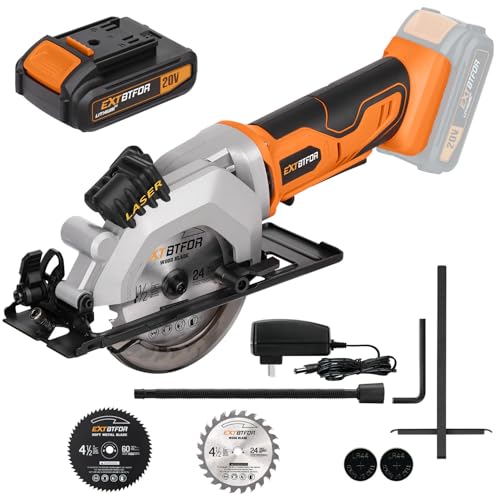
Best for: DIYers making small, cordless cuts
The Extbtfor cordless circular saw is a compact 20V tool for wood, soft metal, and plastic projects. Its 2.0A battery removes the need for a power cord, while the 4-pound body should be manageable for short, one-handed cuts. A 4-1/2-inch blade keeps the saw smaller than a full-size circular model, but it also limits the material thickness it can handle.
At a 90-degree setting, the saw cuts up to 1-11/16 inches deep. That drops to 1-1/8 inches at the maximum 45-degree bevel. The package includes three blade options, including 4-1/2-inch HSS and TCT blades, plus a guide ruler and laser guide. The laser uses two replaceable button batteries, and the kit includes a charger, Allen wrench, dust pipe, manual, and warranty card. At around $76, it offers a useful starter setup for light home repairs and craft projects.
Pros
- Cordless 20V design works away from outlets and extension cords.
- 4-pound weight makes short, controlled cuts easier to manage.
- Adjustable depth reaches 1-11/16 inches at 90 degrees.
Cons
- The 4-1/2-inch blade limits this saw to smaller workpieces and shallower cuts than full-size models.
- Battery runtime and charging time are not specified, which makes longer projects harder to plan.
3. GALAX PRO Mini Circular Saw

Best for: Home DIY cutting in tight spaces
The GALAX PRO is a compact corded circular saw for small woodworking and remodeling jobs. Its 4-amp copper motor reaches 3,500 RPM without a load, with enough capacity for softwood, plywood, PVC pipe, and drywall. The saw cuts up to 1-11/16 inches deep at 90 degrees, or 1-1/8 inches at 45 degrees. At 5.5 pounds, it should fit comfortably in a tool bag and feel easier to position than a full-size circular saw. It costs around $50, though prices change.
Its strongest feature set combines basic cutting control with useful accessories. A built-in red laser helps line up cuts, while the rip guide supports straighter passes along boards. The package includes two 4-1/2-inch, 24-tooth TCT blades with 3/8-inch arbors, plus a hex key for changes. A 1-1/4-inch vacuum adapter can connect to a shop vac for indoor work. The rubberized handle supports one-handed use, but this is still a small corded saw, not a replacement for a larger model on thick lumber or demanding construction work.
Pros
- Two included TCT blades reduce the need for an immediate accessory purchase.
- Laser and rip guide help with alignment and longer straight cuts.
- Compact 5.5-pound body suits overhead work and tight spaces.
Cons
- The power cord restricts movement and requires a nearby outlet.
- Maximum depth limits it to lighter-duty boards and sheet materials.
2. WORKPRO 20V Cordless Mini Circular Saw

Best for: DIY cuts in wood, plastic, and tile
This compact 20V saw suits home projects, workshop repairs, and outdoor cutting where a full-size circular saw feels excessive. Its 4-1/2-inch blade reaches up to 1-11/16 inches at 90 degrees, or 1-1/8 inches at a 45-degree bevel. A 4.36-pound body should be easier to control during short cuts, while the rubberized handle supports one-handed use. The motor reaches 4,500 RPM with no load.
The kit includes a 4.0Ah lithium-ion battery and a 2.4A charger, which can take about two hours to charge one pack. You also get three blades: a 24-tooth alloy blade for wood, a 60-tooth blade for wood and plastic, and a diamond blade for tile. A parallel guide and laser guide aim to keep cuts straighter. The dust tube connects to a vacuum through the included adapter. Depth and bevel controls add flexibility, though the small blade remains better for thinner stock than heavy framing lumber.
Pros
- Three included blades cover wood, plastic, and tile work.
- 0° to 45° bevel adjustment handles angled cuts.
- Battery, charger, guide, dust tube, and storage bag come included.
Cons
- The 1-11/16-inch maximum depth limits thick lumber and larger projects.
- Only one battery is included, and charging can take about two hours.
1. SEESII Mini Circular Saw

Best for: DIY homeowners cutting mixed materials
The SEESII Mini Circular Saw is a compact, corded tool with a 4.8-amp motor and a no-load speed of up to 4,000 RPM. Its 4½-inch blade size suits smaller renovation jobs, furniture work, shelving, and craft projects. The package includes three blade types: TCT for wood, HSS for soft metal, and diamond for tile and similar materials. At around $45, it offers useful flexibility without requiring separate blades for every project.
A laser guide and guide rails can help keep cuts straighter, while the included dust hose adapter connects with most household vacuums. Cutting depth reaches 1-11/16 inches at 90 degrees and 1-1/8 inches at a 45-degree bevel. The base tilts from 0 to 45 degrees for angled cuts. A power switch and safety lock must be pressed together, and the lighter body is about half the weight of a standard 7¼-inch circular saw. That can make short, one-handed cuts easier, though users still need firm control and proper eye protection.
Pros
- Three 4½-inch blades support wood, soft metal, tile, and plastic projects.
- Laser guidance, guide rails, and vacuum hookup support cleaner, straighter cuts.
- Adjustable depth and 0 to 45-degree bevel settings cover common DIY cuts.
Cons
- The cord limits reach and requires a nearby outlet or extension cord.
- Its 1-11/16-inch maximum depth is too shallow for thick lumber and some construction work.
Buying Guide
A mini circular saw is only useful if its cutting depth matches your projects. Check the maximum depth at 90 degrees first, because a tool that cannot pass through your material in one cut wastes time and may bind.
- Cutting depth: Look for at least 1-1/8 inches at 90 degrees for 2-by lumber, or about 1-5/8 inches if you need to cut 2-by material in one pass. Check the listed depth at 45 degrees too.
- Blade size and type: Common models use 3-3/8- to 4-1/2-inch blades. Choose a saw with easy-to-find blades, such as 24-tooth wood blades and carbide options for other materials.
- Power source: Corded saws suit long sessions near an outlet. Cordless versions should include a battery, or budget $40-$100 for a compatible battery and charger.
- Weight and handling: Aim for roughly 4-7 pounds with the battery installed. A lockable trigger, rubber grip, and clear sightline help with controlled cuts.
- Safety and support: Prioritize a blade guard that retracts freely, a dust port, and a two-year warranty or longer. Confirm replacement parts remain available.
If you cannot have everything, prioritize cutting depth that fits your thickest regular material.
Frequently Asked Questions
How do you choose a mini circular saw?
Choose a mini circular saw by matching its cutting depth, blade size, power source, and safety features to your materials. For occasional plywood and trim, a cordless model with a 4-1/2-inch blade may be easier to control, while heavier work favors a corded tool with a deeper cut and steadier power.
What materials can a small circular saw cut?
A mini circular saw can cut wood, plywood, laminate, plastic, and, with the correct blade, thin metal. Check the listed depth before buying, since a 4-1/2-inch wood blade often cuts about 1-1/2 inches at 90 degrees, while thicker boards require multiple passes or a larger saw.
Can mini saws replace full-size circular saws?
Mini saws can replace a full-size circular saw for light cuts in trim, plywood, laminate, and thin boards, but they are not a full substitute for structural lumber or long, deep cuts. Many compact models cut roughly 1-1/2 inches deep, so check the maximum depth at 90 degrees before starting a project.
Are cordless mini circular saws worth buying?
Cordless mini circular saws are worth buying when portability, quick setup, and work away from outlets matter more than unlimited runtime. A model with a 20-volt battery may handle trim and sheet goods well, but spare batteries add cost and a single charge can limit longer cutting sessions.
Conclusion
SEESII Mini Circular Saw is the top recommendation for DIYers who want a compact tool for small wood, plastic, or repair jobs. If your priority is longer cutting sessions or thicker stock, choose a corded compact model instead, since it avoids battery changes and may offer greater cutting capacity. Before buying, double-check the saw’s size, material and blade compatibility, included blade or battery quantity, and current price. Also confirm the handle is manageable, the guard moves freely, and replacement discs are easy to find. A small saw should fit your workload, not only your storage space, so choose the option that fits your projects and budget.