
The NAACOO Gutter Downspout Extension Catch Basin is the best downspout drainage pipe choice for most buyers because its basin design helps collect and redirect roof runoff at ground level. It is a practical option for homes that need a cleaner transition from a vertical gutter outlet to a yard drainage route, especially where surface water gathers near the foundation.
This guide is for homeowners replacing a cracked extension, planning a new drainage path, or trying to stop splashback near the house. The key factors are the basin and pipe sizes, connection compatibility, material durability, and access for clearing leaves or mud. The six picks below are ranked by fit for common yard layouts, with clear reasons and honest drawbacks for each. Check outlet dimensions and local drainage rules before buying, since a good fit still needs a suitable discharge point.
Quick Comparison
| # | Product | Best For | Price | |
|---|---|---|---|---|
| 1 | NAACOO Gutter Downspout Extension Catch Basin | Best for buried drainage collection | ~$26 | View → |
| 2 | NAACOO 8-Ft Pipe with Connector | Best for long-distance water routing | ~$13 | View → |
| 3 | Prestantious Downspout Extender Pipe | Best for compact yard extensions | ~$35 | View → |
| 4 | Prestantious Catch Basin Drain Kit | Best for underground downspout drainage | ~$40 | View → |
| 5 | Ogutter Rain Gutter Downspout Extension | Best for standard gutter systems | ~$15 | View → |
| 6 | Rodnsurw Flexible Downspout Extensions | Best for flexible placement around obstacles | ~$24 | View → |
6 Top Downspout Drainage Pipe Picks
These six drainage pipe picks are ranked by performance, durability, and installation needs, counting down to the top choice.
6. Rodnsurw Flexible Downspout Extensions

Best for: Homeowners redirecting foundation runoff
The Rodnsurw set includes two flexible gutter downspout extensions, each adjusting from 21 to 60 inches. Together, the drains can connect for a maximum reach of about 116 inches. That range suits homes where a fixed elbow or short outlet cannot move rainwater far enough from the foundation. The pipes use thickened polypropylene, a plastic designed to resist tearing and cracking. They can also bend around obstacles and hold a shaped path.
The package includes four adapters and eight screws. Installation involves stretching each drain to the needed length, attaching the ends, and securing the pipe to the downspout. The split design may also work for burial in soil, though the ground path needs careful planning to prevent crushing or blockage. This set offers useful reach for under $25, but results depend on your downspout size and yard slope. Its weather-resistant design is suited to sun, snow, and freezing conditions, but long-term performance will still depend on installation and exposure.
Pros
- Adjustable lengths cover short runs from 21 inches up to 60 inches.
- Two extensions can connect for roughly 116 inches of total reach.
- Includes four adapters and eight screws for securing the drains.
Cons
- The flexible pipes may need support or careful shaping on uneven ground.
- Adapter compatibility should be checked before purchase, especially with unusual downspout sizes.
5. Ogutter Rain Gutter Downspout Extension

Best for: Short runs away from home foundations
The Ogutter downspout extension redirects water away from a house, garden bed, or walkway. Its flexible drain pipe adjusts from 21 to 66 inches, so it can handle short drainage gaps without cutting a rigid tube. The pipe has a thick construction and can support up to 10 pounds without deforming. It may also be buried underground for a cleaner yard setup.
Two adapters fit downspouts measuring 2 x 3, 3 x 3, or 4 x 3 inches. Eight included screws help hold the adapter in place and reduce slipping. Multiple pipe sections connect by rotating them together, which helps with longer drainage paths. The pipe bends into different shapes and can return to its original form. The box includes one extendable pipe, two adapters, eight screws, and instructions. At around $15, it offers a low-cost way to move runoff farther from the foundation.
Pros
- Extends from 21 to 66 inches for adjustable drainage distances.
- Flexible pipe bends around corners and keeps its shape.
- Includes two adapters and eight screws for several downspout sizes.
Cons
- A 66-inch maximum length may not reach a distant drainage area.
- Adapter compatibility is limited to the listed downspout dimensions.
4. Prestantious Catch Basin Drain Kit

Best for: Patios needing shallow runoff control
This Prestantious catch basin kit collects standing water and redirects it through a flexible underground pipe. Its low-profile basin needs less digging than deeper drainage boxes, making it useful beside patios, walkways, lawns, and landscaped areas. The pipe has a 2-inch inside diameter and a 2.4-inch outside diameter.
The included pipe expands from 4.6 feet to 16.4 feet, so it can reach a suitable discharge point around many small residential areas. The pipe and basin arrive separately and require assembly. You expand the tubing, then screw it into the connector without an adapter. The flexible material can bend around landscaping and change direction as needed. If more reach is necessary, a separate 8.2-foot section is available. At around $40, this kit offers a practical way to move moderate rainwater away from foundations and open patios.
Pros
- Low-profile basin requires less digging than many deeper catch basins.
- Flexible 2-inch pipe adjusts from 4.6 to 16.4 feet.
- Screw connection avoids extra adapters and simplifies assembly.
Cons
- The basin and pipe arrive separately, so installation requires assembly.
- It is designed for moderate runoff, not heavy flows from large roofs or severe storms.
3. Prestantious Downspout Extender Pipe
Best for: Redirecting runoff from foundations
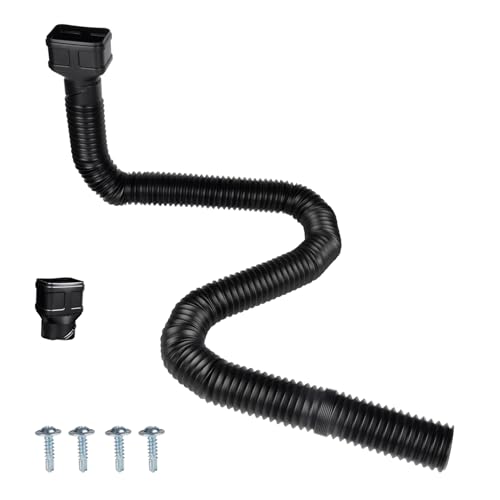
The Prestantious downspout extender is a flexible drainage pipe for moving rainwater away from your home. It expands from 3.6 feet to 16.5 feet, so it can cover short runs or longer paths across a lawn, patio, or landscaped area. The pipe measures 2.6 inches inside and 3.1 inches outside. Check those measurements before buying, especially if you plan to bury it or connect it to another drainage fitting.
The package includes one adapter for a 2-by-3-inch downspout and another for a 3-by-4-inch downspout. Choose the matching piece, attach it with the included screws, then twist the pipe into place. Its flexible construction lets you shape the route around plants, walkways, and other obstacles. At around $35, it costs more than a short rigid extension, but the 16.5-foot reach can reduce the need for several connected sections. The pipe is intended for moderate water flow, not heavy drainage from large collection systems.
Pros
- Covers distances from 3.6 to 16.5 feet.
- Includes adapters for two common downspout sizes.
- Flexible design can route water around landscaping and walkways.
Cons
- The 2.6-inch inside diameter may limit flow during heavy rain.
- Buyers must verify the pipe size and choose the correct adapter before installation.
2. NAACOO 8-Ft Pipe with Connector

Best for: Extending NAACOO basin drainage runs
This add-on pipe gives a NAACOO catch basin another 8 feet of drainage length. It measures 2 inches across and includes a connector for joining it to the existing flexible pipe. Multiple sections can connect together, which helps when one run cannot reach far enough from a foundation, garden bed, or low area. It is made from polypropylene, or PP, and can be bent, shaped, cut, extended, or shortened to fit the route.
The pipe’s main advantage is placement flexibility. It can hold a chosen shape instead of staying rigid, so it works around corners and uneven ground. The material is described as UV resistant, frost resistant, and suitable for underground use without corrosion. Those claims help outdoor buyers, but installation still matters. A buried run needs proper grading and a stable trench. At around $13, this is a relatively inexpensive way to expand a compatible drainage setup, especially for catch basins that support drainage from both sides.
Pros
- Adds 8 feet of length to a 2-inch NAACOO drainage run.
- Flexible PP construction can bend and hold its shape.
- Multiple sections can connect for longer routes.
Cons
- It is designed for NAACOO catch basins, so compatibility with other systems may be limited.
- The pipe alone does not provide a complete drainage installation, and buried runs need careful grading and support.
1. NAACOO Gutter Downspout Extension Catch Basin
Best for: Diverting runoff from home foundations
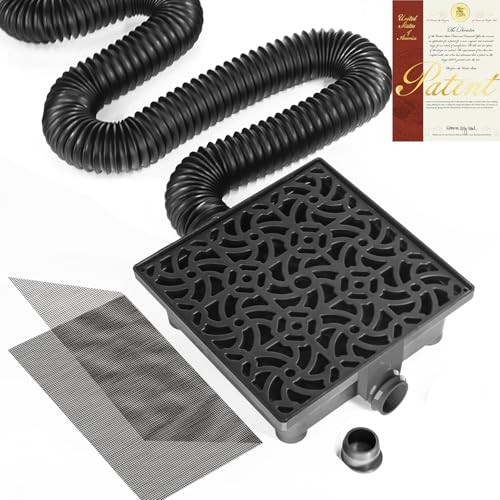
The NAACOO system combines a 12 x 12-inch catch basin with an adjustable PP drainpipe. The pipe compresses to about 2.5 feet and extends to 8 feet, so it can route water around flower beds, patios, or foundation walls. It fits common 2 x 3-inch, 3 x 4-inch, and 3 x 3-inch downspouts. The package includes one basin, one grate, one filter screen, one blockage plug, an 8-foot pipe, and two hose clamps. It costs around $26, though prices can change.
Its double-outlet design gives you more routing options. You can cut the pipe for drainage on both sides, or close one outlet with the supplied plug. The basin has a sloped interior to reduce standing water and debris buildup. The flexible PP tubing holds its shape after positioning and can connect to another section for a longer run. The grate catches leaves, while the finer screen handles smaller debris. The low-profile, black basin blends better with soil than grass, and the design is covered by U.S. Patent No. D1018796.
Pros
- Adjustable pipe length covers runs from 2.5 to 8 feet.
- Two outlets support one-sided or split drainage.
- Grate and filter screen help limit pipe blockages.
Cons
- The black finish may look obvious on lawns.
- Screens and the basin still need periodic cleaning, especially near trees.
Buying Guide
The most important factor is pipe diameter, because a line that cannot carry roof runoff may back up near the foundation. For most homes, a 4-inch outlet and drainage line provide a practical starting point.
- Diameter: Choose 4-inch pipe for typical residential gutters. Use 6-inch pipe for large roofs, several downspouts, or areas with intense rainfall.
- Pipe type: Select solid pipe to move water away from the house. Use perforated pipe only for controlled soil drainage, not as the main downspout extension.
- Material: PVC offers smooth interior walls and strong connections. Corrugated polyethylene costs less and bends around obstacles, but its ridges can trap debris.
- Burial depth: Bury the line at least 6 inches deep in mild climates, or below the local frost line where freezing could lift or split the pipe. Maintain a slope of about 1 inch per 10 feet.
- Fittings and length: Buy enough straight pipe for the full route, plus two 45-degree elbows instead of one sharp 90-degree bend. A 20- to 50-foot kit often suits one downspout.
If you cannot meet every requirement, prioritize proper diameter and a continuous slope away from the foundation.
Frequently Asked Questions
How deep should downspout drainage pipe be buried?
Bury downspout drainage pipe about 12 inches deep for typical yard drainage, with more depth where local frost or traffic requires it. A 4-inch line is common, and the trench should slope roughly 1/8 to 1/4 inch per foot toward its outlet. Keep the outlet visible and away from the foundation.
What size pipe works best for a downspout?
A 4-inch-diameter pipe is usually the right size for one residential downspout, while larger roofs or multiple outlets may need 6 inches. Choose a solid-wall line for carrying water away, not a perforated drain, and confirm its fittings match the downspout adapter. Check the roof area before choosing a larger size.
Can flexible downspout tubing run underground?
Flexible downspout tubing can run underground, but solid pipe is usually better for long, buried runs because it resists crushing and holds its slope. Use flexible sections near bends or connections, then transition to rigid tubing within a few feet. Protect shallow lines under driveways with deeper burial or a sleeve.
Are solid or perforated drainage pipes better for downspouts?
Solid drainage pipe is better for moving downspout water to an outlet, while perforated pipe is designed to release water into surrounding soil. Use solid tubing from the downspout to a safe discharge point, often 10 or more feet from the foundation, and reserve perforated sections for a separate soakaway or drainage trench.
Conclusion
NAACOO Gutter Downspout Extension Catch Basin is the top choice for homeowners who want a simple way to move roof runoff away from foundations, patios, and walkways without building a full underground drainage system. If your priority is a cleaner, permanent installation, choose a buried solid-wall drain kit instead, since it can carry water farther underground and leave less equipment visible around the house. Before buying, double-check the basin and pipe size, confirm that the connector matches your existing downspout, verify how many pieces come in the package, and compare the current price across retailers, because included fittings and bundle sizes can change. A proper fit matters more than a low sticker price when water must flow reliably.