
The DEWALT DCD806B 20V Hammer Drill is the best hammer cordless drill for most buyers. Its main strength is the balance between drilling power and a manageable size, making it useful for wood, metal, and occasional masonry work. This bare-tool model fits DEWALT’s 20V MAX battery system, but the battery and charger come separately.
This guide is for homeowners, DIY users, and tradespeople who need cordless drilling for repairs, installations, and light construction. The key factors are weight, chuck size, masonry capacity, and battery life. A lighter tool feels easier overhead, while a larger chuck and stronger hammer action handle tougher materials. The 6 picks below are ranked with clear reasons and honest drawbacks for each.
Quick Comparison
| # | Product | Best For | Price | |
|---|---|---|---|---|
| 1 | DEWALT DCD806B 20V Hammer Drill | Heavy-duty masonry drilling | ~$128 | View → |
| 2 | DCA ADJZ2055i 20V Brushless Hammer Drill | Budget brushless DIY drilling | ~$60 | View → |
| 3 | Deshuo 1" Rotary Hammer Drill | One-inch concrete hole drilling | ~$55 | View → |
| 4 | DEWALT DCH273B 20V MAX SDS Rotary Hammer Drill | Low-vibration concrete chiseling | ~$259 | View → |
| 5 | DEWALT DCD798B Cordless Hammer Drill Driver | Compact home repair drilling | ~$89 | View → |
| 6 | DCA 12V Cordless SDS-Plus Hammer Drill | Lightweight SDS-Plus chiseling | ~$35 | View → |
6 Top Cordless Hammer Drills to Consider
The list is ranked by power, battery options, drilling control, and value, counting down to the top pick.
6. DCA 12V Cordless SDS-Plus Hammer Drill

Best for: DIY users drilling small masonry holes
The DCA 12V cordless drill combines hammer drilling, standard drilling, and screwdriving in one compact tool. Its SDS-Plus setup accepts the included masonry bits, while the 3/8-inch drill chuck handles regular bits for wood and metal. The 1-joule motor delivers up to 900 RPM and 5,600 BPM. Rated capacities reach 1/2 inch in concrete, 3/8 inch in wood, and 5/16 inch in steel.
Two 2.0Ah lithium batteries help keep small projects moving. The included 3A charger can fill one battery in about 40 minutes, according to the product listing. A trigger provides variable speed control, although fully pressing it selects a fixed speed. An LED light helps with dim corners, and the battery indicator shows remaining charge. At around $35, the kit includes four SDS-Plus bits, a chuck, charger, tool kit, and both batteries. That is a useful package for basic repairs and light home projects.
Pros
- Three functions cover masonry drilling, regular drilling, and screwdriving.
- Two 2.0Ah batteries reduce downtime during short projects.
- Four included bits cover common concrete hole sizes up to 1/2 inch.
Cons
- The 12V motor and 1-joule impact rating suit light-duty work, not large or repeated concrete drilling.
- The included bit selection is limited, so wood, metal, and specialty tasks may require extra bits.
5. DEWALT DCD798B Cordless Hammer Drill Driver

Best for: DIY drilling with one battery system
The Dewalt DCD798B is a cordless drill driver for wood, metal, and masonry projects. It uses the 20V MAX battery platform and a brushless motor, plus a 1/2-inch chuck that accepts larger bits than many compact models. Its hammer-drill setting adds impact for drilling into brick, block, and similar materials. This is a tool-only package, so you will need a compatible battery and charger. At around $89, it can be a practical addition to an existing Dewalt 20V MAX collection.
The brushless motor is the main draw. It avoids carbon-brush replacement and can help keep the tool’s design simpler over time. The 1/2-inch chuck also gives this drill a wider bit range than models with smaller chucks. The hammer mode adds flexibility for occasional masonry work, though it does not replace a dedicated rotary hammer for heavy concrete drilling. Since the package excludes the battery, runtime depends on the 20V MAX pack you already own. Buyers starting from scratch should include that extra cost in the budget.
Pros
- Brushless motor avoids routine carbon-brush replacement.
- 1/2-inch chuck accepts larger drill bits and accessories.
- Hammer-drill mode supports occasional masonry drilling.
Cons
- Tool-only package excludes the battery and charger.
- Hammer mode is less suitable for frequent heavy concrete work.
4. DEWALT DCH273B 20V MAX SDS Rotary Hammer Drill
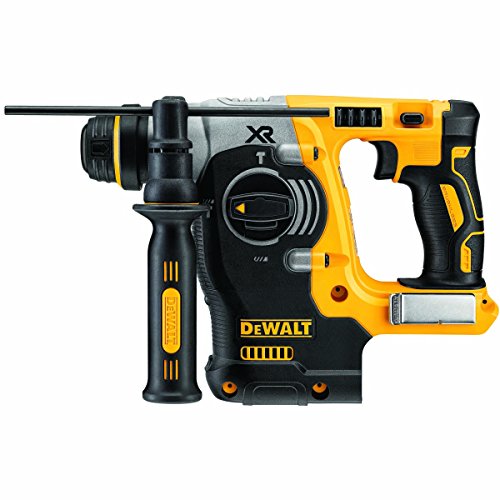
Best for: Cordless concrete drilling and anchors
The DEWALT DCH273B is a cordless SDS rotary hammer for concrete, masonry, and similar fastening work. Its brushless motor delivers 2.1 joules of impact energy, enough for drilling anchor holes and other concrete tasks. A rotating dial switches among drill, hammer drill, and chip modes, so one tool covers three applications. This is a bare tool, meaning the 20V MAX battery and charger come separately.
Its strongest feature is control during longer overhead jobs. DEWALT’s SHOCKS Active Vibration Control reduces vibration felt at the handles compared with rotary hammers without that system. The lightweight design suits rod hanging, seismic and safety attachments, cable tray and strut mounting, clamp mounting, and rail mounting. A German-engineered mechanism works with the brushless motor for runtime and durability, though actual battery life depends on the pack and material. Around $259, it makes more sense for existing DEWALT 20V MAX users. Pair it with the DWH303DH onboard extractor for OSHA Table 1 compliance.
Pros
- 2.1 joules of impact energy support concrete drilling.
- Three modes handle drilling, hammer drilling, and light chiseling.
- Vibration control reduces shaking at the handles.
Cons
- Battery and charger are not included with this bare tool.
- The 2.1-joule output is less suited to heavy demolition than larger rotary hammers.
3. Deshuo 1″ Rotary Hammer Drill
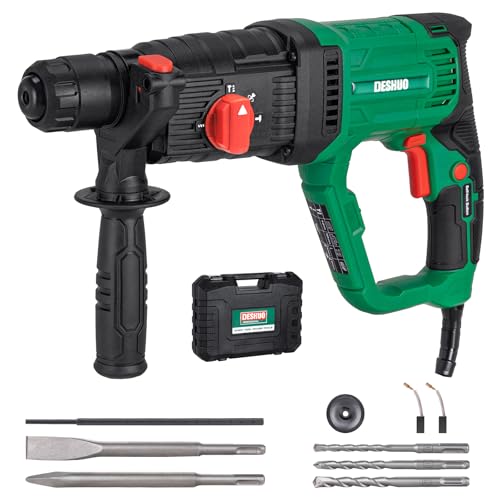
Best for: DIY concrete drilling and tile removal
The Deshuo 1-inch SDS-Plus rotary hammer is built for drilling concrete, cement, brick, masonry, and tile. Its 9-amp motor reaches up to 1,100 RPM and 5,300 BPM, with 2.21 foot-pounds, or 3 joules, of impact energy. At 7.19 pounds, it is lighter than many larger demolition hammers and suits overhead or downward drilling. Around $55, it targets homeowners who need more impact than a standard drill can provide.
Four modes cover common masonry tasks. Rotary hammer mode handles concrete holes, while rotary-only mode suits lighter work in brick or masonry. Hammer-only mode helps remove tile, and the chisel adjustment mode lets you set the tool’s angle. The SDS-Plus chuck allows bit changes without a separate key, but it accepts only SDS-Plus bits. Forward and reverse controls can help free a stuck bit, and the variable-speed trigger includes a lock button. A safety clutch, vibration control, and a 24-month warranty add useful support for routine DIY projects.
Pros
- Strong masonry performance: The 9-amp motor delivers up to 3 joules of impact energy for concrete and brick drilling.
- Useful mode selection: Four settings cover drilling, light rotary work, tile removal, and chisel positioning.
- More controlled handling: The safety clutch, vibration control, and variable-speed trigger help during longer jobs.
Cons
- Limited bit compatibility: It requires SDS-Plus bits and cannot use regular drill bits or SDS-Max accessories.
- Not for heavy demolition: Its lightweight design suits DIY work, but larger demolition projects may require a stronger tool.
2. DCA ADJZ2055i 20V Brushless Hammer Drill

Best for: Home repairs and light masonry work
The DCA ADJZ2055i is a 20V cordless hammer drill for drilling, driving, and masonry jobs. Its 400W brushless motor produces up to 492 in-lb of torque, with two speed ranges from 0-450 and 0-1,800 RPM. An impact rate of 27,000 blows per minute helps with brick and other masonry surfaces. The 1/2-inch all-metal keyless chuck accepts common drill bits and supports holes up to 3/4 inch in wood, 1/2 inch in steel, or 1/2 inch in brick, according to the listed specifications.
The drill weighs about 1.3kg and includes a rubberized grip, LED light, and belt hook for general repair work. Its 18+1+1 settings provide useful control for screws and smaller drilling tasks. Around $60, the kit includes a 2.0Ah battery and charger, nine drill bits, 19 screwdriver bits, an extension holder, flexible shaft, onboard bit holder, and carrying bag. That broad accessory set adds value for occasional household projects. The compact design should fit tighter spaces, though the small battery may limit work time on demanding jobs.
Pros
- Brushless motor delivers up to 492 in-lb of torque.
- Two speeds and 18+1+1 settings support controlled driving.
- Kit includes 28 bits, charger, battery, and storage bag.
Cons
- The included 2.0Ah battery may need frequent charging during heavy drilling.
- Hammer action suits light masonry better than large concrete projects.
1. DEWALT DCD806B 20V Hammer Drill

Best for: Pros drilling in wood, metal, and masonry
This DEWALT DCD806B is a 20V MAX XR brushless cordless hammer drill for drilling and driving without a power cord. It uses a 1/2-inch metal ratcheting chuck, which accepts larger bits and helps hold them securely. The tool-only package does not include a battery or charger, so the around-$128 price is best viewed as a bare-tool cost. Its two-speed transmission runs from 0 to 650 rpm or 0 to 2,000 rpm, with a variable-speed trigger for measured starts.
The main safety feature is an anti-rotation system that can shut the drill down when it senses excessive rotational movement. A red LED indicates when that protection engages. The adjustable three-position work light produces 70 lumens and turns off automatically. DEWALT rates the drill for up to 175 holes per charge, though battery size and material affect that figure. It is also Tool Connect chip ready, but the chip is sold separately. Power comparisons are manufacturer estimates, not independent results.
Pros
- 1/2-inch metal ratcheting chuck supports strong bit retention.
- Two speed ranges cover controlled drilling and faster hole making.
- Three-position, 70-lumen light helps in dim work areas.
Cons
- Battery and charger are not included, adding cost for new users.
- The 175-hole runtime claim varies with battery size and material.
Buying Guide
For a hammer-equipped cordless drill, the battery platform is the most important factor. A compatible 18V or 20V system can power other tools, while an aging platform may make replacement batteries expensive.
- Battery and runtime: Choose an 18V or 20V model. A 2.0Ah battery suits light repairs, but a 4.0Ah pack lasts longer for repeated masonry drilling. Two batteries reduce downtime.
- Hammer performance: Look for at least 25,000 beats per minute and 400 inch-pounds of torque for brick, block, and occasional concrete holes. A side handle improves control.
- Chuck size: A 1/2-inch keyless chuck accepts larger masonry and wood bits than a 3/8-inch chuck. Metal chucks usually handle frequent use better than plastic versions.
- Speed and control: Select two mechanical speeds, roughly 0-500 and 0-2,000 rpm, plus 15 or more clutch settings. A separate hammer mode prevents unnecessary impact on delicate materials.
- Kit contents and price: Expect about $120 to $250 for a kit with the drill, charger, two batteries, and case. Confirm that the package includes a side handle and belt hook.
If you cannot have everything, prioritize the battery platform, then choose the highest torque and hammer rate within that system.
Frequently Asked Questions
How much power should a hammer cordless drill have for home projects?
An 18-volt hammer cordless drill provides enough power for most home projects, including wood, metal, and occasional masonry. Choose a model with at least 50 Nm of torque and two speed ranges for better control. For frequent concrete drilling, a brushless 20-volt model with a side handle will feel more capable.
What features matter most when choosing a cordless hammer drill?
The most useful features are variable speed, adjustable torque, a hammer setting, and a 1/2-inch chuck. A brushless motor can improve runtime and durability, while a 2.0Ah battery keeps weight down. For larger jobs, choose a kit with two batteries, each rated at 4.0Ah or more.
Can a battery-powered hammer drill make holes in concrete?
Yes, a battery-powered hammer drill can make small holes in concrete when paired with a masonry bit and enough battery power. It works best for anchors and light-duty drilling, not large holes. Use a 3/8-inch or 1/2-inch bit, clear dust often, and avoid forcing the tool.
Are cordless hammer drills good enough for heavy construction work?
Cordless hammer drills are suitable for light and medium construction tasks, but rotary hammers are better for repeated or large concrete holes. A drill rated around 18 to 20 volts can handle anchors and small fasteners, while a rotary hammer is the better choice for holes above 1/2 inch.
Conclusion
The DEWALT DCD806B 20V Hammer Drill is the top choice for homeowners, remodelers, and tradespeople who need strong drilling power in wood, metal, and masonry. If your priority is easier overhead work or tighter spaces, pick a smaller compact hammer drill instead, since its shorter body and lower weight can reduce hand fatigue during longer jobs. Before buying, double-check the tool’s size, battery compatibility, included quantity, and current price, because this bare-tool model may not include a battery or charger, and bundle prices can change. Also confirm that your existing DEWALT 20V batteries fit the exact kit you select, then compare the warranty and included accessories.