
The ARB CKBLTA12 12V Brushless Air Compressor is the top pick for most buyers because its brushless motor is built for repeated inflation while keeping the unit portable. For drivers seeking the best brushless air compressor for trail repairs, tire pressure checks, and routine inflation, this model is a strong starting point.
This guide is for off-road drivers, campers, and anyone who wants a compressor in the vehicle instead of relying on a gas station. The key factors are physical size, power source, inflation speed, duty cycle, and included hose or fittings. A small unit saves storage space, while a longer duty cycle helps with larger tires. The 5 picks below are ranked with clear reasons and honest drawbacks for each, so you can match the compressor to your vehicle and maintenance needs.
Quick Comparison
| # | Product | Best For | Price | |
|---|---|---|---|---|
| 1 | ARB CKBLTA12 12V Brushless Air Compressor | Heavy-Duty Off-Road Tire Inflation | ~$950 | View → |
| 2 | ARB CKBLTP12 12V Brushless Portable Air Compressor | Portable Trailside Air Adjustments | ~$1380 | View → |
| 3 | ARB CKBLA12 12V Brushless Air Compressor | Frequent Four-Wheel-Drive Tire Maintenance | ~$560 | View → |
| 4 | OlarHike Portable Tire Inflator Air Compressor | Emergency Roadside Tire Top-Offs | ~$30 | View → |
| 5 | ARB CKBLP12 Brushless Air Compressor | Compact Garage Air Supply | ~$834 | View → |
5 Top Brushless Compressor Picks
This list is ranked from fifth place down to the top brushless compressor pick, with key strengths and tradeoffs.
5. ARB CKBLP12 Brushless Air Compressor
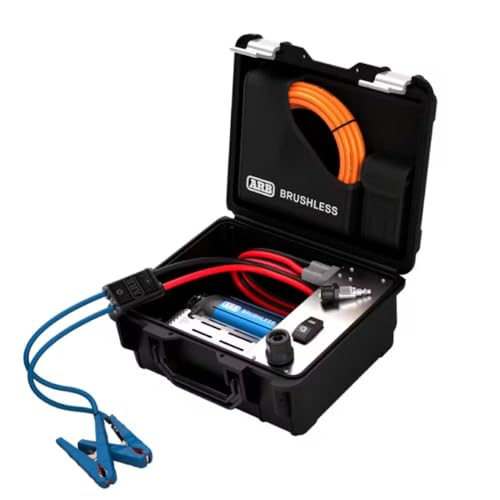
Best for: Frequent 4×4 drivers needing faster onboard inflation
The ARB CKBLP12 is a premium portable air compressor for 4×4 travel, trail repairs, and repeated tire inflation. Its brushless motor produces about 50% more output than ARB’s current brushed compressor, or roughly 1.5 times the output. That should reduce inflation time, especially after lowering tire pressure for sand, mud, or rocky tracks. At around $834, it targets serious off-road users rather than occasional drivers.
Cooling is a major part of the design. Each motor and compressor assembly has its own fan, which helps manage heat during demanding sessions. Electronic speed control adjusts operation across different pressure and ambient temperature conditions. The unit also monitors voltage, current, temperature, and motor stalls, then adjusts its operation to reduce damage risks. Cam-lock quick-release mounts let you remove the onboard assemblies without a long teardown. The brushless setup also removes the need for separate relays, which can simplify installation. Still, buyers will need suitable mounting space and vehicle wiring.
Pros
- Produces 50% more output than ARB’s brushed compressor.
- Dual active cooling fans support repeated inflation sessions.
- Voltage, overload, and temperature monitoring protect the system.
Cons
- Around $834 is a steep price for occasional tire inflation.
- Installation still requires vehicle mounting and power connections.
4. OlarHike Portable Tire Inflator Air Compressor

Best for: Drivers needing roadside tire top-offs
The OlarHike is a compact tire inflator for cars, SUVs, motorcycles, bicycles, and sports balls. It weighs 1.2 pounds and measures 6.5 by 2.76 by 2.17 inches, so it can stay in a trunk or backpack. Its three built-in 2,000mAh batteries inflate a 195/65 R15 tire from 30 to 35 PSI in about 55 seconds. A 235/65 R17 SUV tire takes about 2.2 minutes for the same 5-PSI increase.
Its dual-power design adds useful flexibility. Run it cordlessly, or connect the included 12V cable for longer jobs. A large dual LED display shows current and target pressure, while auto shut-off stops at the selected level. Four modes cover cars, motorcycles, bicycles, and sports equipment. The unit also includes a USB output, flashlight, storage bag, hose, ball needle, and French valve adapter. Around $30, it offers a practical emergency option, but its 51-PSI limit rules out heavy-duty pickup tires and RVs.
Pros
- Inflates a standard car tire by 5 PSI in about 55 seconds.
- Battery power supports up to 18 stated car-tire top-offs.
- Auto shut-off, preset modes, and four pressure units simplify operation.
Cons
- The 51-PSI maximum does not suit heavy-duty pickups or RVs.
- Battery charging requires a 5V 2A or 5V 3A adapter, which may limit convenient charging.
3. ARB CKBLA12 12V Brushless Air Compressor

Best for: Frequent 4×4 tire inflation
The ARB CKBLA12 is a 12V brushless air compressor designed for permanent vehicle installation. ARB claims 50% more output than its current brushed compressor, or about 1.5 times the airflow. That can shorten inflation stops after lowering tire pressure on sand, rocks, or dirt roads. It targets drivers who need more than a compact emergency inflator, especially those carrying larger off-road tires.
Cooling is built into the design. Each motor and compressor assembly has its own fan, helping control heat during demanding inflation jobs. Electronic speed control adjusts operation across changing pressure and ambient temperature conditions. The unit also monitors voltage, current, motor stalls, and temperature, then adjusts to protect the compressor and vehicle power supply. Cam-lock quick-release mounts allow the onboard unit to come out without removing the whole mounting system. ARB also removes the need for separate relays, which can simplify wiring. At around $560, this is a serious investment for a 2025 model, not a casual accessory.
Pros
- 50% higher claimed output can reduce tire inflation time.
- Separate cooling fans support repeated, high-load use.
- Voltage and overload protection helps guard against electrical faults.
Cons
- Around $560 makes it expensive for occasional tire inflation.
- Permanent installation still requires suitable mounting, wiring, and space in the vehicle.
2. ARB CKBLTP12 12V Brushless Portable Air Compressor

Best for: Serious off-roaders with onboard air needs
The ARB CKBLTP12 is a 12-volt twin-motor air compressor designed for permanent vehicle installation. It uses brushless motors, which have fewer wearing parts than brushed designs. ARB rates this model at 9.18 CFM at 0 psi and 6.20 CFM at 29 psi, with a maximum pressure of 150 psi. Its 100% duty-cycle rating supports repeated inflation work without scheduled cool-down breaks.
The compressor measures 14.49 by 13.31 by 6.69 inches and weighs 15.8 pounds. An IP67 rating provides protection against dust and temporary water exposure, but it does not make the unit fully waterproof. Built-in fans continue running after use, while electronic speed control adjusts operation across changing pressure and temperature conditions. Protection against voltage changes, overloads, and motor stalls adds useful safeguards. Quick-release mounts simplify removal for service. The package includes a 20-foot air hose, tire chuck, and blow gun. At around $1,380, this is a major investment for a vehicle compressor.
Pros
- Twin brushless motors deliver ARB’s claimed 50% output increase over its comparable brushed compressor.
- A 100% duty-cycle rating supports repeated tire inflation without planned cooling pauses.
- The 20-foot hose reaches all four tires and works with the included chuck and blow gun.
Cons
- Around $1,380, it costs far more than portable compressors for occasional trail or roadside use.
- The 90-amp maximum draw may require careful wiring, battery capacity, and installation planning.
1. ARB CKBLTA12 12V Brushless Air Compressor

Best for: 4×4 owners airing up multiple tires
The ARB CKBLTA12 is a 12-volt, twin-motor onboard air compressor for trucks and off-road vehicles. Its brushless motors deliver 50% more output than ARB’s comparable brushed model. Rated airflow reaches 9.18 CFM at 0 psi and 6.20 CFM at 29 psi, with a maximum pressure of 150 psi. The system carries a 100% duty-cycle rating, so it is designed for extended inflation sessions without scheduled cooling breaks.
Active cooling gives each motor its own electronically controlled fan. Those fans may continue running after shutoff to manage heat. Electronic speed control adjusts motor operation as pressure, temperature, and vehicle voltage change. Protection against voltage swings, overloads, and motor stalls adds useful safeguards. The unit also provides audio and visual status alerts. Cam-lock mounts allow the compressor assembly to come off for service or storage. At 15.8 pounds, it measures 14.49 by 13.31 by 6.69 inches. Around $950, it is a serious investment for frequent off-road use.
Pros
- 50% higher output can shorten tire inflation time.
- Twin brushless motors support a 100% duty-cycle rating.
- IP67 water resistance and voltage protection suit vehicle installations.
Cons
- Around $950 makes it expensive for occasional tire inflation.
- Its 90-amp maximum draw requires substantial wiring and a suitable power system.
Buying Guide
The most important factor is usable airflow, measured in CFM at your tool’s working PSI. A tank may hold pressure, but low CFM can make sanders slow down and nailers pause.
- Airflow and pressure: Match the compressor to the tool. Brad nailers often need 1–2 CFM at 90 PSI, while impact wrenches may require 5–8 CFM at the same pressure.
- Tank size: Choose a 1–6 gallon tank for trim work and short fastening jobs. Pick a 20–30 gallon model for longer spray-painting or grinding sessions.
- Battery system: For cordless models, confirm voltage and battery compatibility. An 18V or 20V unit may share packs with your existing tools, while a 4–8Ah battery provides more capacity than a 2Ah pack.
- Noise rating: Look for a published rating below 70 dB if you work indoors or near living areas. Ratings around 60–65 dB are easier to tolerate for longer periods.
- Duty cycle and recovery: A 50% duty cycle allows about five minutes of operation within a ten-minute period. Check recovery time, since frequent pressure drops can slow repetitive tasks.
If you cannot have everything, prioritize CFM at your tool’s required PSI, since inadequate airflow limits what the compressor can run.
Frequently Asked Questions
How do brushless air compressors work?
They use an electronic motor controller instead of carbon brushes to spin the pump. This design removes brush wear and can reduce maintenance over the compressor’s service life. Many portable models use oil-free pumps and compact tanks from about 1 to 6 gallons, but exact noise, pressure, and runtime figures vary by model.
What are brushless air compressors good for?
Brushless air compressors are good for light to medium tasks such as inflating tires, powering nailers, and spraying small amounts of finish. Their lower maintenance needs suit occasional users. Check the tool’s air demand first, since a framing nailer may need 2 to 3 CFM while a tire inflator needs far less.
Can a brushless air compressor run a nail gun?
Yes, a brushless compressor can run a nail gun if its delivered airflow and tank size match the gun’s requirements. Finish nailers often use less air than framing nailers, so compare the compressor’s CFM at 90 PSI with the tool’s stated requirement. A 1-gallon tank may suit short jobs, not rapid firing.
Are brushless air compressors quieter than brushed models?
Usually, brushless air compressors can run more quietly than comparable brushed units, but pump design, fan noise, and enclosure matter just as much. Check the listed decibel rating instead of relying on the motor type alone. A difference of 5 dB can sound noticeable, while rubber feet may reduce vibration.
Conclusion
ARB CKBLTA12 12V Brushless Air Compressor is the top pick for drivers who want a compact, vehicle-ready inflator for tire repairs, air lockers, or regular off-road use. If your priority is maximum airflow for larger tires, choose a higher-capacity 12V or dual-cylinder model instead, since it can reduce refill time. Before buying, double-check the compressor’s dimensions, vehicle and tire compatibility, included accessories, quantity, and current price, because packages and listings can change. Also confirm the power connection and hose length fit your setup. A brushless motor can support long-term use, but it does not replace sensible duty-cycle limits or proper storage. Pick the model that matches your tires, space, and expected workload.