
The AEOCKY 5500 Sq. Ft. Dehumidifier is the best basement dehumidifier for most buyers because its stated 5,500-square-foot coverage fits many large, damp lower levels. That broad reach can reduce the need for multiple smaller machines, especially in open basement layouts. It is a practical pick for homeowners who want one unit to manage moisture across a sizable area.
This guide is for anyone comparing a basement moisture remover for laundry rooms, storage areas, finished spaces, or whole lower levels. Focus first on coverage, then check water-tank capacity and drainage options. A unit may cover a large area, but a small tank can mean frequent emptying. Continuous-drain support can reduce that chore when a floor drain sits nearby. The seven picks below are ranked with clear reasons and honest drawbacks for each, so you can match the machine to your space and routine.
Quick Comparison
| # | Product | Best For | Price | |
|---|---|---|---|---|
| 1 | AEOCKY 5500 Sq. Ft. Dehumidifier | Large-home moisture control | ~$250 | View → |
| 2 | BEDRED Dehumidifier | Quiet bedroom humidity relief | ~$60 | View → |
| 3 | 21-Pint Basement Dehumidifier | Damp basement owners | ~$120 | View → |
| 4 | AEOCKY Max Dehumidifier | Whole-house humidity management | ~$170 | View → |
| 5 | BANABIE 2500 Sq. Ft. Dehumidifier | Medium-apartment moisture control | ~$120 | View → |
| 6 | Waykar 34-Pint Dehumidifier | Laundry room drying support | ~$176 | View → |
| 7 | Waykar 80-Pint Dehumidifier | Severe moisture recovery needs | ~$220 | View → |
7 Top Basement Dehumidifier Picks
These basement dehumidifiers are ranked by moisture control, capacity, and value, counting down to our top pick.
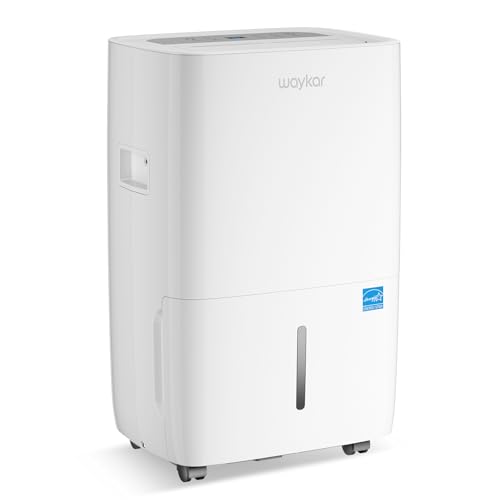
7. Waykar 80-Pint Dehumidifier
Best for: Large, damp basements and living areas
The Waykar 80-pint dehumidifier is designed for spaces up to 5,000 square feet, including basements, bathrooms, bedrooms, and RVs. Its 80-pint rating applies to 95°F and 90% relative humidity, so real-world removal will vary with room temperature and moisture levels. Around $220, it offers a wide 30% to 80% humidity setting range, a 24-hour timer, and automatic swing airflow across 90 degrees.
A built-in 4.3-liter tank handles manual draining, while the included 3.3-foot hose supports continuous gravity drainage through a standard 3/4-inch garden hose connection. The unit is ENERGY STAR certified and DOE compliant, with automatic defrost and overload protection for extended operation. Waykar lists noise around 42 dB, although actual sound can change with fan speed and compressor cycling. The one-year warranty can gain another year after registration.
Pros
- Covers large areas, with a rated capacity for spaces up to 5,000 square feet.
- Offers flexible humidity control from 30% to 80%, below the 40% minimum found on many models.
- Includes both tank drainage and continuous hose drainage, reducing daily emptying.
Cons
- The 4.3-liter tank is modest for an 80-pint unit, so manual draining may be frequent in very damp conditions.
- Continuous drainage needs a suitable floor-level drain because the included hose relies on gravity.
6. Waykar 34-Pint Dehumidifier

Best for: large basements and damp garages
The Waykar 34-pint dehumidifier is designed for spaces up to 2,000 square feet. Its stated 34-pint daily capacity applies at 95°F and 90% relative humidity, so real-world removal will vary with room conditions. Around $176, it offers two fan speeds and a manual 90-degree airflow adjustment. You can set humidity from 30% to 80%, including lower settings for storage areas, crawlspaces, or post-rain drying.
Its 2.5-liter removable tank suits routine use, while the included hose supports continuous drainage for longer operation. A 24-hour timer, full-tank shutoff, and auto-restart after a power outage add useful convenience. Energy Star certification may help control running costs, and built-in defrost and overload protection support use in cooler spaces. Waykar lists a one-year warranty, with an option to extend coverage to two years through the manual. The unit is designed for quieter operation in bedrooms or offices, though no decibel rating is provided.
Pros
- Covers spaces up to 2,000 square feet with a stated 34-pint daily capacity.
- Offers a wide 30% to 80% humidity setting range.
- Supports continuous drainage and includes a 24-hour timer.
Cons
- The 2.5-liter tank may require frequent emptying during very humid periods.
- Continuous drainage needs a suitable drain and careful hose placement.
5. BANABIE 2500 Sq. Ft. Dehumidifier

Best for: Damp basements and larger rooms
The BANABIE dehumidifier is rated for spaces up to 2,500 square feet and can remove up to 32 pints of moisture per day under 95°F and 90% relative humidity conditions. Its rotary compressor, humidity sensor, and three operating modes support everyday moisture control in basements, bedrooms, bathrooms, laundry rooms, and living areas. It costs around $120, though prices can change.
Drainage is flexible. Use the included 3.28-foot hose for continuous gravity drainage, or empty the built-in 2.5-liter tank by hand. That tank is much smaller than the unit’s stated daily removal capacity, so manual draining may become frequent in very damp spaces. The controls let you set humidity from 30% to 90% RH, choose fan speed in Custom Mode, or run Auto and Continuous modes. Noise can drop as low as 32dB under specified conditions. Handles and 360-degree caster wheels help with repositioning, while a 24-hour timer, child lock, auto-defrost, power outage memory, and auto shutoff add practical convenience.
Pros
- Covers spaces up to 2,500 square feet, making it suitable for larger basements and living areas.
- Offers both hose drainage and a removable 2.5-liter tank for different setups.
- Includes adjustable humidity from 30% to 90% RH, plus Auto, Continuous, and Custom modes.
Cons
- The 2.5-liter tank may require frequent emptying during heavy moisture removal.
- Continuous drainage needs a nearby drain and suitable downward hose placement.
4. AEOCKY Max Dehumidifier

Best for: Small basements needing continuous drainage
The AEOCKY ARION is a compact compressor dehumidifier rated to remove up to 50 pints of moisture per day at 95°F and 95% relative humidity. It is designed for spaces up to 3,000 square feet, yet measures only 8.03 inches deep, 11.1 inches wide, and 15.75 inches tall. The price is around $170, though it changes over time.
Its standout feature is the mix of capacity and footprint. The 0.5-gallon tank fills quickly at high humidity, so the included drain hose is more practical for long runtimes. A 3/4-inch garden hose adapter supports longer drainage routes, but the setup still needs a suitable downhill path. The unit offers continuous, sleep, auto, and constant-humidity modes, with settings from 40% to 80%. A brushless DC motor, copper tubing, hydrophilic fins, and automatic defrost support its efficiency claims. Casters and a built-in handle make repositioning easier. AEOCKY lists a three-year warranty and ETL certification.
Pros
- Compact 8.03-by-11.1-by-15.75-inch body fits tight storage areas.
- Gravity-drain hose and 3/4-inch adapter reduce tank emptying.
- Multiple humidity modes include auto control from 45% to 55%.
Cons
- The 50-pint rating comes from hot, extremely humid test conditions, so real-world removal can be lower.
- The small 0.5-gallon tank may require frequent emptying without a nearby drain or hose route.
3. 21-Pint Basement Dehumidifier

Best for: Damp basements and laundry rooms
This 21-pint compressor dehumidifier targets spaces up to 1,600 square feet. Its listed removal rate comes from testing at 95°F and 90% relative humidity, so actual results will vary with room conditions. A built-in sensor lets you choose humidity from 30% to 80%, while automatic control cycles the unit on and off as needed. Auto-defrost helps it operate in cooler areas, including many basements.
The unit offers DEHU, DRY, and CONT modes. DRY mode can help with damp laundry, while CONT mode suits persistently humid rooms. Its 0.52-gallon tank shuts the machine off when full, and the included drain hose supports ongoing drainage when connected to a suitable outlet. Controls include fan-speed adjustment, a timer, and child lock. At around $120, it costs more than compact models, but the 360-degree wheels and lift-up handles make room-to-room movement easier. The stated 34dB noise level may appeal to sleepers, though compressor sound can vary by operating mode.
Pros
- Covers spaces up to 1,600 square feet.
- Offers tank collection or hose-based continuous drainage.
- Includes humidity control, three modes, timer, and child lock.
Cons
- The 21-pint rating is daily moisture removal, not tank size.
- Continuous drainage requires a suitable drain location, and performance depends on room temperature and humidity.
2. BEDRED Dehumidifier

Best for: bedrooms and small damp rooms
The BEDRED is a compact thermoelectric dehumidifier priced around $60. Its semiconductor cooling system pulls moisture from indoor air without using a compressor. The water tank holds 95 ounces, and an automatic shutoff stops the unit when the tank fills. BEDRED lists it for spaces up to 1,000 square feet, though that coverage claim may not hold in a wet basement.
Its most noticeable extra is the built-in seven-color ambient light. You can cycle through colors such as blue, green, and red, or turn the lighting off in Sleep Mode. That mode also reduces operating noise for nighttime use. The compact shape should fit on a dresser, shelf, bathroom counter, or RV surface. At this price, the light and auto-stop controls add convenience, but this remains a small thermoelectric appliance rather than a high-capacity moisture remover. Rooms with heavy condensation may need a stronger compressor model.
Pros
- The 95-ounce tank gives a compact room unit useful capacity.
- Auto shutoff stops operation when the water tank is full.
- Seven light colors and Sleep Mode suit bedrooms or relaxing spaces.
Cons
- Thermoelectric cooling usually removes moisture more slowly than compressor dehumidifiers.
- The advertised 1,000-square-foot coverage may not suit very damp basements or open floor plans.
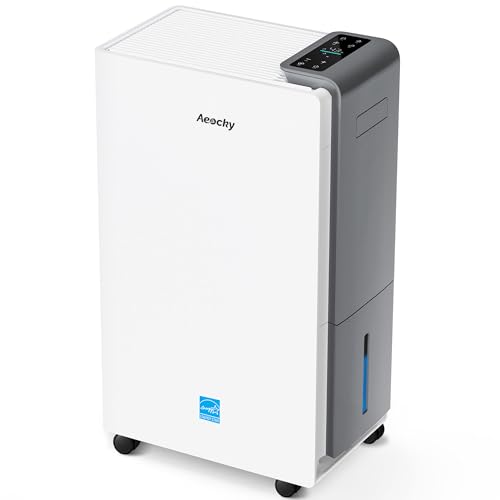
1. AEOCKY 5500 Sq. Ft. Dehumidifier
Best for: Large basements and whole-home moisture control
The AEOCKY RHEA-001 is a compressor dehumidifier rated for spaces up to 5,500 square feet. It claims up to 80 pints per day at 95°F and 95% relative humidity, or 56 pints at 86°F and 80% humidity. Those figures describe moisture removal, not tank capacity. At around $250, it costs more than many basic basement units.
Its ENERGY STAR Most Efficient 2025 certification is the main draw. The unit uses 7 mm pure copper tubing, a “3+2” coil structure, and blue hydrophilic aluminum fins. A humidity sensor, automatic restart memory, and low-temperature defrost system add useful everyday features. AEOCKY lists operation down to 65°F, a 44 dB low setting, 14.45 by 8.66 by 24.09 inches dimensions, and a 31-pound weight. The purchase includes three-year coverage, according to the manufacturer.
Pros
- ENERGY STAR Most Efficient 2025 certification may reduce power use compared with less efficient models.
- Automatic restart memory works with a smart plug after power returns.
- Copper tubing, low-temperature controls, and three-year coverage support long-term basement use.
Cons
- The 80-pint rating applies to very hot, extremely humid conditions, not typical rooms.
- At 31 pounds, it is fairly heavy to move between floors, despite its compact footprint.
Buying Guide
The most important factor is moisture-removal capacity, measured in pints per day. A unit that is too small may run constantly, while an oversized model can cost more and cycle less effectively.
- Capacity: Choose 30 pints per day for basements up to about 500 square feet, 45 to 50 pints for 500 to 1,000 square feet, and 50 to 70 pints for larger or very damp spaces. Add capacity for laundry areas, leaks, or poor insulation.
- Drainage: A 1.5- to 2-gallon tank reduces emptying, but continuous drainage is more convenient. Confirm that the model includes a hose connection, and check whether it needs a floor drain or a built-in pump.
- Humidity control: Look for an adjustable humidistat covering roughly 30% to 80% relative humidity. A basement setting near 45% to 50% helps limit musty odors and mold growth.
- Energy use: Prefer an ENERGY STAR-certified unit. Compare annual energy estimates, since two similarly sized models can differ by more than $30 per year in electricity costs.
- Noise and features: A noise rating near 50 to 55 decibels suits finished basements. Auto restart, frost protection, washable filters, and a full-tank shutoff add practical value.
If you cannot have everything, prioritize capacity and reliable drainage, since those directly affect moisture control and daily maintenance.
Frequently Asked Questions
How large should a basement dehumidifier be?
Choose a dehumidifier rated for your basement’s square footage and moisture level, not just its room size. A 30-pint unit often suits a moderately damp space up to about 1,500 square feet, while very wet rooms may need 50 pints or more. Check the manufacturer’s coverage chart before buying.
What humidity level should a basement dehumidifier maintain?
Set the unit to keep basement humidity between 40% and 50%. This range helps limit musty odors, condensation, and mold growth without making the air uncomfortably dry. Use a separate hygrometer to verify the reading, since the built-in sensor may measure a slightly different area.
Can a basement dehumidifier run continuously?
Yes, a basement dehumidifier can run continuously when humidity stays high, provided it has proper airflow and safe drainage. Use a continuous hose to a floor drain, or empty the tank as needed. Many models restart automatically after a power outage, but confirm that feature in the manual.
Are basement dehumidifiers expensive to operate?
No, most basement dehumidifiers cost roughly $5 to $25 per month to operate, depending on power use, electricity rates, and runtime. For example, a 500-watt unit running eight hours daily uses about 120 kilowatt-hours monthly. Actual costs vary, so check the energy label and your utility rate.
Conclusion
AEOCKY 5500 Sq. Ft. Dehumidifier is the top pick for homeowners with large, damp basements who need strong coverage and fewer emptying cycles. If your priority is lower upfront cost or a smaller room, choose a compact unit instead, since oversized models can use more power than necessary. Before buying, double-check the rated room size, drain-hose compatibility, water-tank capacity, and current price for the quantity you need. Also consider where the appliance will sit, because a floor drain or sump area can make continuous drainage easier. Look for adjustable humidity controls and an auto-shutoff feature if the basement stays unattended. A little planning can prevent noise, overflow, and poor moisture control.