
The Cadet F Series Electric Baseboard Heater is the best budget baseboard heater for most buyers because its simple electric design offers dependable room heating at a modest price. Available in multiple lengths and wattages, this steel baseboard unit can fit common room layouts without adding complicated controls or extra features. Its low profile also works well beneath windows, where baseboard heaters typically belong. Buyers should confirm the required voltage, wattage, and heater length before ordering, since the wrong combination can cause installation problems or weak heating performance.
This guide is for shoppers who need affordable supplemental heat for bedrooms, offices, or other living spaces. The most important factors are the heater’s physical size and its wattage, which affect installation and room coverage. The five picks below are ranked with clear reasons and honest drawbacks for each, so you can compare them before buying.
Quick Comparison
| # | Product | Best For | Price | |
|---|---|---|---|---|
| 1 | Cadet F Series Electric Baseboard Heater | Fixed-Room Supplemental Heating | ~$50 | View → |
| 2 | Cadet F Series 3F750W Electric Baseboard Heater | Small Room Heat Control | ~$54 | View → |
| 3 | Cadet Convection Baseboard Heater | Quiet Whole-Room Warmth | ~$80 | View → |
| 4 | Cadet Portable Electric Baseboard Heater | Portable Rental-Friendly Heating | ~$155 | View → |
| 5 | Baseboard Heater Cover with Endcap | Baseboard Cover Replacement Projects | ~$50 | View → |
5 Budget Baseboard Heaters Worth Considering
The list is ranked by value, heating coverage, controls, and installation needs, counting down to the top pick.
5. Baseboard Heater Cover with Endcap

Best for: Updating worn covers without remodeling
This 4-foot baseboard heater cover is an adjustable replacement for older radiator covers and exposed heating elements. Its 1-to-4-foot range suits many standard pipes and radiant floor heating systems, with no cutting required. The package includes an end cap, so it can create a finished look at one end of the run. At around $50, it costs more than a basic plastic grille but may fit several room layouts.
The cover uses powder-coated metal instead of plastic. That material resists rust, corrosion, dents, warping, and cracking from normal baseboard heat. Perforated panels allow warm air to move through the room while covering the heating element. Rounded edges also reduce sharp contact points around children and pets. Installation uses a snap-on design, so it does not require drilling or major wall work. Still, buyers should confirm their existing baseboard dimensions and attachment points before ordering. A cover that fits the length may not fit every pipe layout.
Pros
- Adjustable from 1 to 4 feet, making it useful for different room sizes.
- Powder-coated metal handles heat and wipes clean with a damp cloth.
- Snap-on installation avoids drilling, cutting, and professional installation.
Cons
- Compatibility is not universal, so pipe depth and mounting points need careful checking.
- The package appears to include one end cap, which may not finish both ends of a longer run.
4. Cadet Portable Electric Baseboard Heater

Best for: Small rooms needing movable supplemental heat
The Cadet Portable Electric Baseboard Heater provides 1,500 watts of convection heat through a standard 120-volt outlet. Its 49-inch steel body uses aluminum fins and a steel-sheathed heating element to spread warmth without a fan. A six-foot grounded cord connects directly to the wall, while built-in handles make room-to-room moves easier. At around $155, it costs more than many compact space heaters, but its long baseboard design suits bedrooms, offices, and small living areas.
A large dial thermostat controls the temperature and includes an off setting. There is no wall control to install. The heater produces 5,120 BTUs and runs near silently because it has no moving parts. Safety features include a tip-over switch and a high-temperature shutoff. The powder-coated white finish should fit most rooms, and the unit is made in the USA with a two-year warranty. Use it only with a wall outlet, not an extension cord or power strip.
Pros
- Six-foot grounded cord allows plug-in setup without hardwiring.
- Fan-free convection runs quietly in bedrooms and offices.
- Tip-over and overheat protection add useful safety controls.
Cons
- The 49-inch length takes more floor space than a compact heater.
- A 120-volt wall outlet must be nearby, and extension cords are not allowed.
3. Cadet Convection Baseboard Heater

Best for: Quiet bedroom heating up to 175 sq. ft.
The Cadet Convection Baseboard Heater is a 1,000-watt electric unit for indoor rooms such as bedrooms, offices, and smaller living areas. Its 120V design combines radiant and convection heat, so it warms air without using a fan. The listed coverage reaches up to 175 square feet, though room insulation, ceiling height, and outdoor temperatures will affect results.
Its strongest feature is quiet operation. With no fan motor, it should produce less operating noise than fan-forced heaters, which suits sleeping areas. The wall-mount design also keeps the floor clear, while the white rectangular housing gives it a simple appearance. Built-in safety features add protection during normal use, but buyers should still follow the installation and clearance instructions. At around $80, it offers a fairly direct way to add heat to one room without installing a full heating system.
Pros
- Covers rooms up to 175 square feet with 1,000 watts of heat.
- Fan-free operation reduces noise in bedrooms and living spaces.
- Wall mounting saves floor space and keeps the heater out of walkways.
Cons
- The 1,000-watt output may not adequately heat larger, poorly insulated, or very cold rooms.
- Wall installation requires accurate placement and suitable electrical connections, which may call for professional help.
2. Cadet F Series 3F750W Electric Baseboard Heater
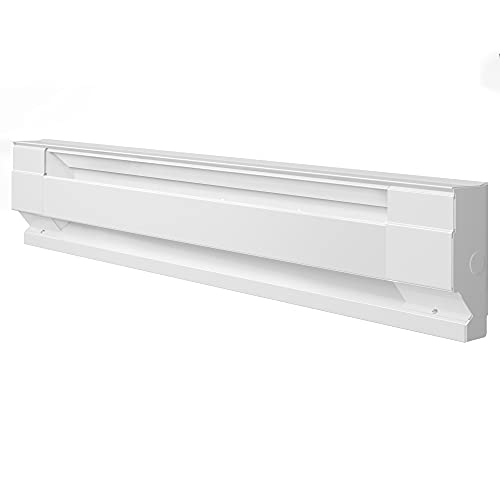
Best for: Supplemental heat in small rooms
The Cadet F Series 3F750W is a 36-inch electric baseboard heater for rooms that need fixed, wall-mounted heat. It runs on either 240 or 208 volts, with selectable output of 750 or 563 watts. That equals about 2,560 or 1,925 BTUs, depending on the electrical supply. The white finish suits many basic room setups, and the low-profile design leaves floor space open.
Its main strength is flexible installation. Universal wiring and pre-punched knockouts can simplify connection for a qualified installer, while convection heat moves warm air through the room without a fan. The package includes one heater only. A limited lifetime warranty also provides longer coverage than many basic heating products. At around $54, it offers a reasonably low-cost option for adding heat to one room, though the final project price can rise if wiring, controls, or professional installation are needed.
Pros
- Supports 240-volt or 208-volt systems, with 750- or 563-watt output.
- Convection heating spreads warmth without adding a fan motor.
- Limited lifetime warranty supports long-term ownership.
Cons
- The 36-inch length requires a clear section of wall for installation.
- The package includes only the heater, so a thermostat or other control may need to be purchased separately.
1. Cadet F Series Electric Baseboard Heater

Best for: Small rooms needing fixed heat
The Cadet F Series 2F350W is a 24-inch electric baseboard heater for supplemental room heating. Its steel body comes in white, so it can blend with many light-colored walls and trim. The unit uses a 240-volt circuit and draws 350 watts. On a 208-volt supply, it operates at 262 watts instead. That makes the electrical setup a key part of choosing this heater.
Its listed heat output is 1,195 BTU at 240 volts and 895 BTU at 208 volts. Those figures suit smaller spaces, enclosed rooms, or areas that need extra warmth rather than whole-home heating. The compact length is useful under windows or along short wall sections. At around $50, it offers a relatively low-cost way to add fixed electric heat, though installation may affect the total price. The plain steel construction also keeps the design simple, with fewer decorative details to match.
Pros
- 24-inch length fits shorter wall spaces and areas beneath windows.
- Steel construction provides a solid housing for regular indoor use.
- Dual 240/208-volt ratings support two common electrical configurations.
Cons
- The 895 to 1,195 BTU range limits it to smaller rooms or supplemental heating.
- It requires a compatible high-voltage circuit, so it cannot plug into a standard household outlet.
Buying Guide
The most important factor is heating capacity, measured in watts and room coverage. An undersized electric baseboard heater may run constantly, while an oversized model wastes money and can create uneven temperatures.
- Room size: Plan on roughly 10 watts per square foot in a well-insulated room, or 12 to 15 watts in a drafty space. A 1,500-watt unit suits about 100 to 150 square feet.
- Voltage and wiring: Confirm whether the heater needs 120 or 240 volts. A 240-volt, 1,500-watt model draws about 6.25 amps, while a 120-volt version draws 12.5 amps.
- Physical length: Measure the available wall space before buying. Common units range from 24 to 72 inches, and clearance around curtains and furniture may reduce usable space.
- Thermostat control: Choose a model with an adjustable thermostat, or budget $20 to $50 for a compatible wall control. A built-in control costs less but may provide less precise room-wide regulation.
- Safety and price: Look for automatic overheat protection and a cool-touch housing. Budget electric models often cost $50 to $150, before professional installation.
If funds are limited, prioritize correct wattage for the room before convenience features or exterior styling.
Frequently Asked Questions
How much does a budget baseboard heater cost?
A budget baseboard heater usually costs about $30 to $150, before installation. Basic electric models often measure 24 to 72 inches long, while labor, wiring, thermostats, and permits can add substantially to the total. Prices vary by wattage, finish, and whether the unit replaces an existing heater.
What size baseboard heater do I need for a room?
Choose a baseboard heater by room size, insulation, climate, and window area, not floor space alone. A common starting estimate is about 10 watts per square foot, so a 100-square-foot room may need roughly 1,000 watts. A heating professional should confirm the circuit and final load.
Can inexpensive baseboard heaters heat a room well?
Yes, inexpensive baseboard heaters can heat a room well when their wattage matches the space and drafts are controlled. As a rough example, a 1,000-watt unit may suit about 100 square feet in average conditions. Cold climates, poor insulation, and high ceilings can require more capacity.
Are electric or hydronic baseboard heaters cheaper to run?
Electric baseboard heaters are usually cheaper to install, while hydronic systems may cost less to run when paired with an efficient boiler. A 1,500-watt electric unit uses 1.5 kilowatt-hours for each hour at full output, so local electricity rates matter. Hydronic installation usually costs more upfront.
Conclusion
The Cadet F Series Electric Baseboard Heater is the top pick for shoppers who want dependable room heat at a modest upfront cost. It fits bedrooms, offices, and other spaces where straightforward electric control matters more than premium features. If your priority is quieter operation or a slimmer look, choose a model with a lower-profile design and a built-in thermostat instead. Before buying, double-check the heater’s length, voltage compatibility, required quantity, and current price, since one unit may not cover a longer wall or larger room. Also confirm the installation method and circuit requirements in the product details. A careful measurement now can prevent returns, wiring surprises, and uneven heating later. That makes the final choice easier and more practical.